

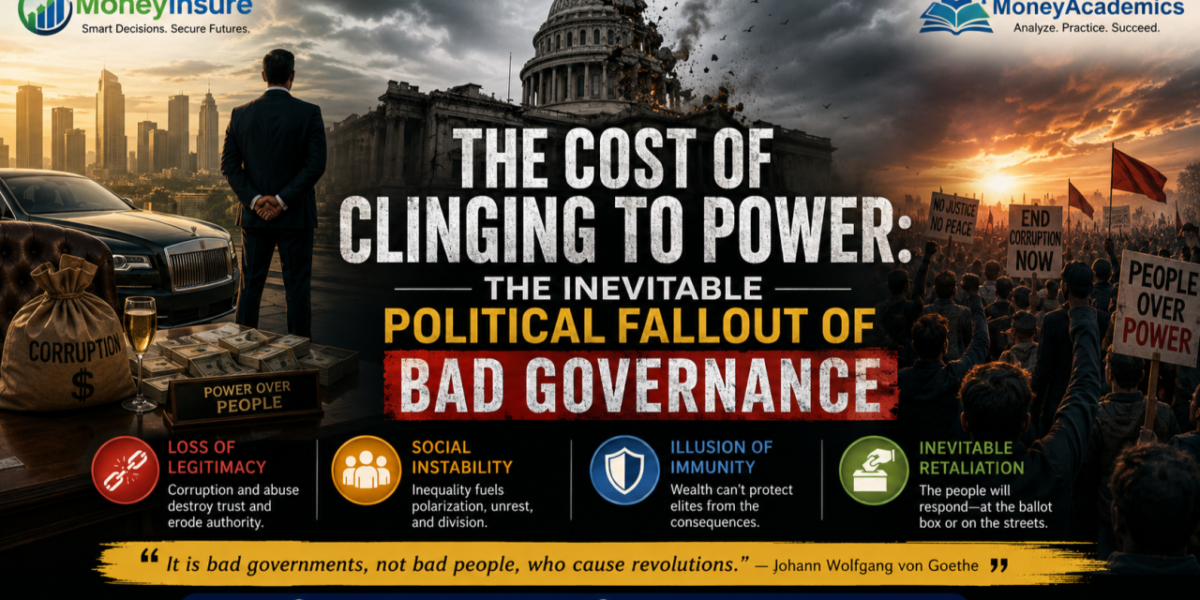
When governments prioritize self-preservation over public service, they trigger a chain reaction that systematically dismantles their own authority. Bad governance is never a localized or temporary problem; it acts as a systemic toxin that ultimately destroys the political legitimacy of those in power. Leaders who ignore the needs of their citizens eventually face severe political consequences, ranging from massive voter retaliation to complete institutional collapse.
1. The Death of Political Legitimacy
A government’s primary currency is trust. When corruption thrives, transparency vanishes, and the rule of law is weaponized to protect the powerful, that currency becomes worthless. Research highlighted by the UNODC Anti-Corruption Module underscores that general governance standards—such as controlling corruption and maintaining the rule of law—have a vastly superior impact on political legitimacy than standard welfare gains. Without legitimacy, state authority relies entirely on coercion.
“Most of the poverty and misery in the world is due to bad government, lack of democracy, weak states, internal strife, and so on.” — George Soros
2. Mass Polarization and Social Instability
Poor governance actively fractures societies. When resources are funneled exclusively to political cronies or hometowns of ministers, marginalized groups are left entirely behind. This inequity breeds severe resentment, destroying social cohesion and forcing citizens to retreat into kinship isolation or tribal politics just to survive.
- Polarized Electorates: Communities fracture along ethnic or regional lines when central systems fail them.
- Institutional Gridlock: Progress grinds to a complete halt as political infighting replaces constructive policymaking.
- Rise of Civil Unrest: Deprived populations increasingly turn to street protests, parallel economies, or outright revolt.
3. The Illusion of Elite Immunity
Rulers and societal elites frequently operate under the dangerous assumption that their wealth will protect them from systemic decay. They build gated communities, purchase private security, and fly abroad for healthcare. However, history proves that political fallout eventually breaches every wall. Economic collapse does not respect bank balances, and total social unrest does not honor zip codes.
“Bad governance doesn’t stay ‘over there.’ It gradually finds its way ‘down here.’ It’s not a local storm. Instead, it’s a rising flood.” — Theatre Igili, PhD
4. The Ultimate Ballot Box and Street Retaliation
The final stage of political fallout is the inevitable removal of the failing regime. In resilient democracies, this manifests as a sweeping electoral rout. In authoritarian setups, it frequently translates into revolution. Citizens will eventually recognize that an incapable, corrupt administration can only exist as long as the population remains compliant.
“It is bad governments, not bad people, who cause revolutions.” — Johann Wolfgang von Goethe
Ultimately, bad governance sets a hard deadline on its own existence. Political leaders cannot indefinitely mismanage public resources, ignore systemic risks, and expect to hold onto power. The resulting political fallout is not a matter of if, but when.