

India has changed dramatically since the Constitution came into force. With a population exceeding 1.4 billion and increasingly complex governance requirements, it is worth reconsidering whether the present maximum strength of 250 members in the Rajya Sabha remains adequate.
- The case for expansion
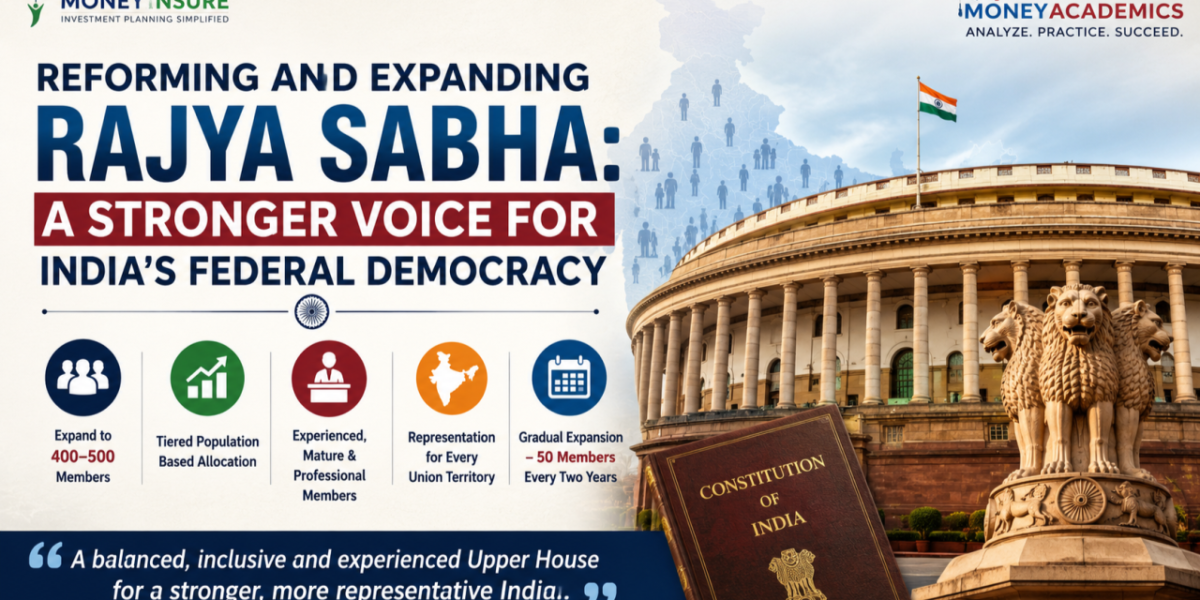
The Rajya Sabha is the Council of States, designed to protect the federal character of India and provide states with a voice in national policymaking. Its strength could be increased to approximately 400–500 members, but expansion should be carefully structured rather than based solely on population.
A tiered population formula could be adopted, with states grouped into broad population categories such as below 10 million, 10–50 million and above 50 million. Smaller states could receive a guaranteed minimum representation, while larger states receive additional seats according to population.
- A House of experience and expertise
The Rajya Sabha has a distinctive role because its members bring maturity, experience, professional knowledge and expertise to parliamentary discussions. Expansion should therefore also provide greater opportunities for experienced professionals, academics, administrators and distinguished persons to contribute to national policymaking.
A larger and more diverse Upper House could improve legislative scrutiny on complex matters such as economics, technology, finance, defence and international relations.
- Representation for every Union Territory
Every Union Territory should have representation in the Rajya Sabha.
For Union Territories having legislative assemblies, members can be elected through the applicable constitutional mechanism. For UTs without legislative assemblies, Rajya Sabha members could be elected through an electoral college consisting of representatives of their local bodies.
This would establish a democratic connection between:
Citizens → Local Bodies → Electoral College → Rajya Sabha
Thus, residents of every Union Territory would have an institutional voice in Parliament.
- Gradual expansion every two years
Instead of increasing the Rajya Sabha’s strength from 250 to 400–500 members immediately, the expansion could take place gradually.
Around 50 additional members could be added every two years, subject to periodic review of population, representation and parliamentary requirements.
This phased approach would allow Parliament to assess the impact of each expansion while providing sufficient time for infrastructure and administrative arrangements.
- Conclusion
Reforming the Rajya Sabha should not simply mean increasing the number of Members of Parliament. It should aim to create a stronger, more representative and more experienced Council of States.
A phased expansion, population-tiered allocation, representation for every Union Territory and greater emphasis on experienced and professional members could strengthen India’s federal democracy while ensuring that both large and small regions have an effective voice in national policymaking.
India’s democratic institutions must evolve with the nation. A stronger Rajya Sabha can help ensure that every region is heard and that national legislation benefits from experience, expertise and balanced federal representation.