
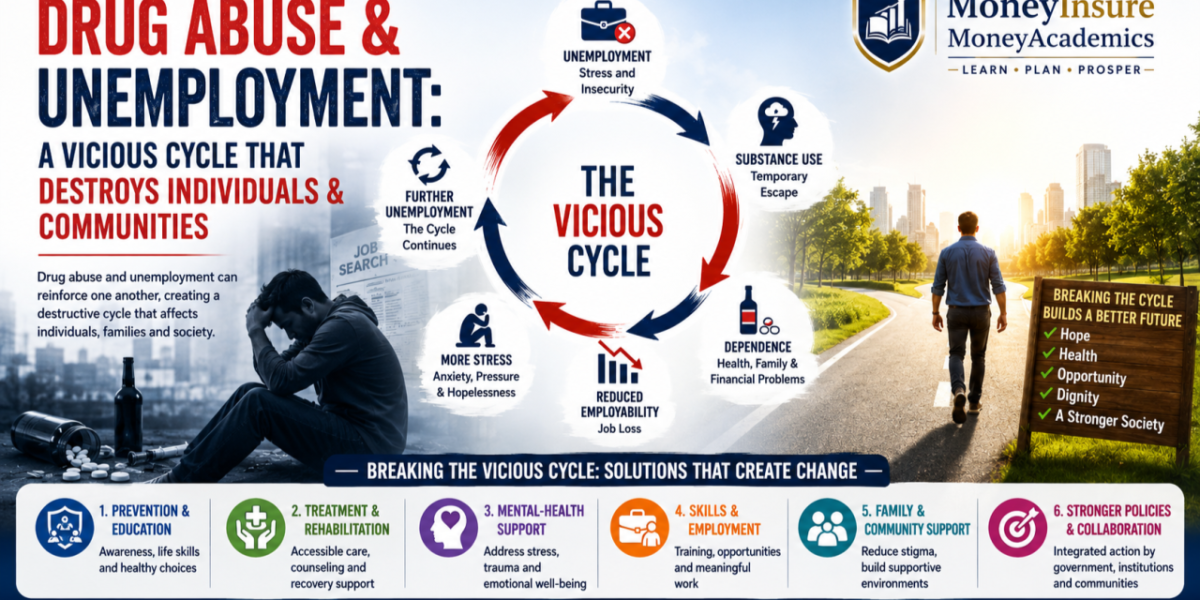
Drug abuse and unemployment can reinforce one another, creating a destructive cycle that affects individuals, families and society. Unemployment can bring financial insecurity, psychological stress, loss of routine and diminished self-esteem. For some vulnerable individuals, drugs may become an unhealthy means of escaping these pressures. At the same time, substance-use disorders can impair health, concentration, reliability and work performance, making it harder to obtain or retain employment. The result can become a vicious circle:
Unemployment → Stress and insecurity → Substance use → Dependence → Reduced employability → Further unemployment
This relationship should not be interpreted as meaning that unemployment inevitably causes addiction or that every person with a substance-use disorder becomes unemployed. Rather, economic insecurity can interact with mental-health problems, family circumstances, trauma, social isolation and the availability of drugs to increase vulnerability.
I. How the Cycle Begins?
Employment provides much more than income. It can provide purpose, routine, social interaction, responsibility and a sense of identity. Losing a job can, therefore, have consequences far beyond the loss of a salary.
A person who suddenly becomes unemployed may experience financial anxiety, uncertainty about the future, social isolation and a loss of confidence. If these pressures continue without adequate support, some individuals may turn to alcohol or drugs as a temporary coping mechanism.
Initially, substance use may appear to provide relief. However, repeated use can develop into tolerance, cravings and dependence. The consequences then begin to create new problems—health deterioration, damaged relationships, financial difficulties and declining employability.
II. The Individual Cycle
Emotional Stress / Job Loss
↓
Financial & Psychological Pressure
↓
Initial Substance Use
↓
Temporary Relief / Escape
↓
Repeated Use & Dependence
↓
Health, Family & Financial Problems
↓
Reduced Employability / Job Loss
↓
More Stress
└──────────────→ Substance Use
The tragedy is that the substance initially used to escape the problem can eventually become one of the major causes of the problem.
III. Unemployment and Substance Use: What the Evidence Shows
Research has identified a significant relationship between employment status and substance use. U.S. national survey data, for example, have historically found illicit-drug use to be considerably higher among unemployed adults than among people working full-time.
Research has also examined the relationship between broader economic conditions and substance-use treatment. Some studies have found that increases in unemployment are associated with increases in treatment admissions for opioids and other substances. However, such findings should be interpreted carefully: correlation does not automatically establish that unemployment itself caused the increase. Economic hardship is one part of a much larger network of factors influencing addiction. The important point is that economic insecurity, social isolation and substance use can reinforce each other, particularly in communities already facing limited opportunities.
IV. From Individual Crisis to Community Crisis
The consequences extend beyond the individual. When substance misuse becomes widespread in economically vulnerable communities, families, workplaces and public institutions can all experience the impact. Communities affected by industrial decline, factory closures or prolonged unemployment may lose not only jobs but also the social and economic infrastructure built around those jobs. Reduced incomes, fewer opportunities and declining community confidence can create conditions in which drug markets and associated social problems become harder to control.
The broader cycle can therefore look like this:
Economic Vulnerability
↓
Unemployment & Social Distress
↓
Greater Vulnerability to Substance Use
↓
Expansion of Illicit Drug Markets
↓
Crime & Social Instability
↓
Pressure on Health and Law-Enforcement Systems
↓
Family & Community Breakdown
↓
Deeper Poverty and Fewer Opportunities
└────────────→ Economic Vulnerability
This demonstrates why the drug menace cannot be treated solely as a law-and-order problem. It is simultaneously a public health, economic, employment, family and community-development challenge.
V. Breaking the Vicious Circle
The solution requires action at several points in the cycle.
1. Prevention and Education
Young people and vulnerable communities need accurate information about addiction, peer pressure and the consequences of substance misuse. Prevention should also provide healthy alternatives—sports, education, skills, community activities and constructive opportunities.
2. Treatment and Rehabilitation
People struggling with substance-use disorders need accessible medical treatment, counseling and rehabilitation. Recovery should address not only physical dependence but also the psychological and social factors that contribute to continued substance use.
3. Mental-Health Support
Unemployment, anxiety, trauma, social isolation and addiction can interact. Mental-health support can therefore be an important part of preventing substance use from becoming a long-term disorder.
4. Skills and Employment
Employment can be an important part of recovery. Vocational training, skill development, apprenticeships, supported employment and job-placement programmes can provide recovering individuals with structure, financial independence and a renewed sense of purpose.
5. Family and Community Support
Recovery becomes more sustainable when individuals are not isolated from their families and communities. Reducing stigma and encouraging supportive environments can help people rebuild relationships and return to productive social and economic life.
VI. The Real Solution
A narrow response focuses only on controlling drugs. Another focuses only on unemployment. Neither approach is sufficient on its own.
The more effective approach is to address both sides of the cycle:
Prevention + Mental-Health Support + Treatment + Family Support + Skills + Employment
Together, these interventions can help replace destructive coping mechanisms with healthier alternatives based on purpose, dignity, stability and opportunity.
VII. Conclusion
Drug abuse and unemployment can create a self-reinforcing cycle that damages individuals and gradually weakens families and communities. Joblessness can intensify financial and psychological pressures, while addiction can reduce a person’s ability to work and participate productively in society.
Breaking this cycle therefore requires more than punishment after addiction has developed. It requires prevention before the problem begins, treatment when it emerges, and meaningful economic opportunities during recovery.
The ultimate goal should not simply be to remove drugs from an individual’s life. It should be to create the conditions in which that individual has a stronger reason to remain drug-free.
Breaking the drug menace means breaking the cycle that sustains it.