

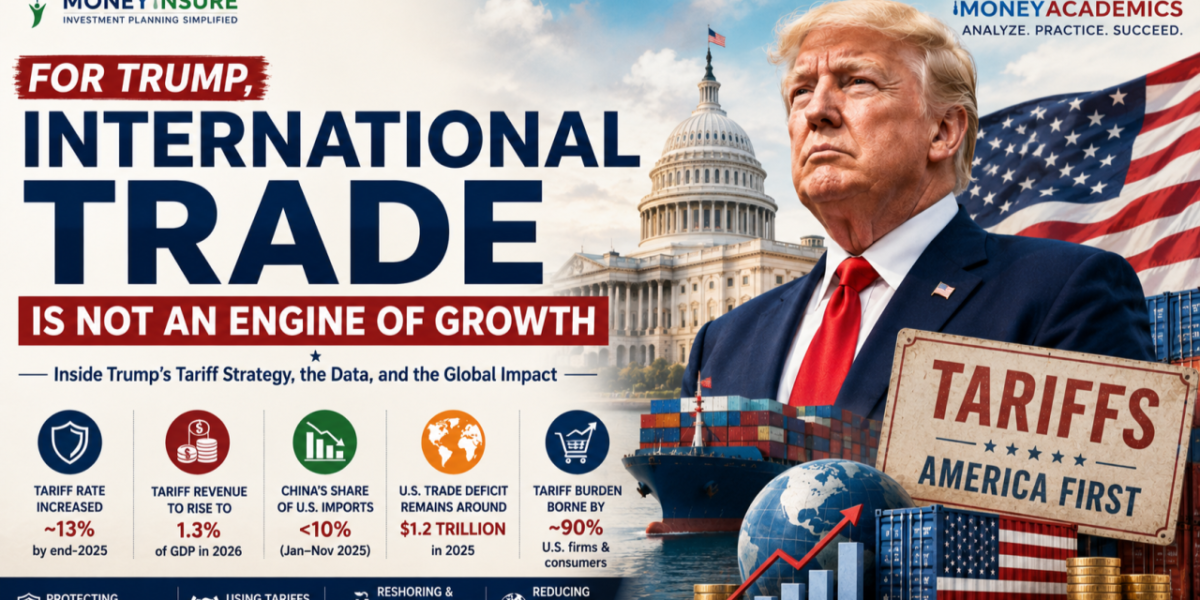
For Donald Trump, international trade is not primarily an engine of economic growth. It is a tool of economic power, protection and negotiation. His “America First” trade philosophy views persistent trade deficits, dependence on foreign manufacturing and unrestricted imports as weaknesses that must be corrected through tariffs, domestic production and stronger bargaining power.
The approach represents a major shift away from the traditional emphasis on lower trade barriers and deeper global economic integration.
1. Trade deficits as a sign of Economic Weakness
Trump has consistently treated large trade deficits as evidence that the United States is losing economic strength to other countries. His policy therefore focuses on:
- Reducing excessive imports;
- Expanding American manufacturing;
- Encouraging companies to produce in the United States;
- Increasing access for U.S. exports abroad; and
- Using America’s huge consumer market as negotiating leverage.
The important difference is that conventional economics does not regard a bilateral trade deficit by itself as proof that one country is “losing.” Trump, however, places much greater emphasis on the trade balance as a measure of economic strength.
2. Tariffs: The central instrument
Trump’s tariff policy serves several purposes:
Protection: Shield selected American industries from foreign competition.
Negotiation: Pressure trading partners to reduce tariffs and other barriers against U.S. products.
Revenue: Increase customs-duty collections.
National Security: Protect industries considered strategically important.
Reshoring: Encourage companies to move production and investment into the United States.
Thus, tariffs are not being used merely as conventional trade taxes. They have become an important instrument of economic and geopolitical policy.
3. The scale of protectionism has increased sharply
The change in U.S. tariff policy has been substantial. The Federal Reserve Bank of New York estimates that the average tariff rate on U.S. imports increased from 2.6% at the beginning of 2025 to about 13% by the end of 2025. Nearly 90% of the economic burden of those tariffs fell on U.S. firms and consumers.
The Congressional Budget Office similarly estimated that, by November 2025, the effective tariff rate was roughly 13 percentage points higher than the approximately 2% rate prevailing in 2024. CBO expects the higher tariffs to raise inflation temporarily and reduce real investment, GDP and employment compared with a scenario without those policy changes
4. Section 301: A new use of Trade Policy
In July 2026, the U.S. Trade Representative took action under Section 301 of the Trade Act of 1974 against 60 economies over their failure to effectively prohibit imports produced with forced labour. The action imposed 10% or 12.5% additional tariffs, subject to exemptions. The 60 economies represented approximately 99.4% of U.S. imports. India was placed in the 10% category because of its measures concerning forced-labour import prohibitions.
This illustrates how Trump’s administration is using trade policy not only to address conventional commercial disputes but also to influence labour standards and global supply chains.
5. Section 232: Trade as National Security
Trump has also expanded the use of Section 232, which permits trade restrictions based on national-security considerations.
In 2026, the administration strengthened tariffs on steel, aluminum and copper. Certain covered steel, aluminum and copper products face a 50% tariff, while specified derivative products face 25%, with some industrial and electrical equipment subject to a temporary 15% rate. The underlying argument is that the United States cannot maintain national security if critical industrial capacity is excessively dependent on foreign suppliers.
6. Section 122: The Post-IEEPA shift
A major legal development occurred in February 2026 when the Supreme Court issued its decision in the International Emergency Economic Powers Act Ruling (IEEPA) tariff litigation. The administration subsequently used Section 122 of the Trade Act of 1974 to impose a temporary 10% import surcharge for 150 days, effective February 24, 2026, to address what it described as fundamental international-payments problems.
This demonstrated that Trump’s tariff strategy was not dependent on a single legal authority; the administration has sought to use several different statutory mechanisms to maintain its protectionist programme.
7. China: The main strategic target
China remains at the centre of Trump’s trade strategy. The objective is not simply to reduce Chinese imports. It is to reduce America’s strategic dependence on China’s manufacturing ecosystem. The change has been significant. According to New York Fed research, China’s share of U.S. non-oil imports fell from nearly 25% in 2017 to around 15% in 2024, and then to below 10% during the first 11 months of 2025. Mexico and Vietnam gained market share during the same period.
However, this also reveals a limitation of tariffs:
Reducing imports from China does not necessarily mean reducing imports from the world.
Production can simply move from China to Vietnam, Mexico, India or other countries. Indeed, New York Fed research found that the overall U.S. trade deficit remained around $1.2 trillion in 2025, almost unchanged from 2024, despite the dramatic changes in the composition of U.S. imports.
8. Who actually pays the Tariffs?
This is one of the most important issues in the debate.
Tariffs are collected by U.S. Customs from U.S. importers. Foreign producers may absorb part of the cost by reducing their prices, but the economic burden can ultimately fall on American companies and consumers.
New York Fed research found that nearly 90% of the economic burden of the 2025 tariffs fell on U.S. firms and consumers.
Therefore, the statement that “foreign countries pay the tariffs” is an over-simplification. The actual economic process is:
Foreign exporter → U.S. importer → U.S. business/retailer → Consumer
Some of the cost can be absorbed by foreign exporters, but much of it remains within the U.S. economy.
9. The global trade map is being rewired
Trump’s tariffs have not stopped international trade. Instead, they are changing its direction.
| Region | Main Policy/Trend | Emerging Effect |
| China | High tariffs and strategic decoupling | Lower share of U.S. imports |
| Mexico & Vietnam | Increased sourcing | Greater share of U.S. imports |
| India | Reciprocal and Section 301 measures | Greater pressure for market access and trade concessions |
| EU & Japan | Negotiations and sector-specific tariffs | Continued pressure for reciprocal trade |
| U.S. Manufacturing | Tariff protection and reshoring incentives | Greater domestic investment in selected sectors |
The important point is that globalization is being reconfigured rather than simply reversed.
10. The economic trade-off
Tariffs can provide benefits to protected industries and encourage domestic investment. They can also generate significant government revenue.
But protection comes with costs. Higher tariffs can:
- Increase the cost of imported inputs;
- Raise prices for consumers;
- Reduce business margins;
- Encourage inefficient production;
- Disrupt international supply chains; and
- Invite retaliation from trading partners.
CBO’s assessment is that the higher tariffs introduced during 2025 would temporarily increase inflation and reduce real investment, GDP and employment compared with a situation without those tariff changes.
Conclusion
Trump’s trade policy represents a fundamental change in the philosophy of international commerce. The traditional economic argument is that international trade can increase prosperity through specialization, competition, larger markets, lower costs & productivity gains. Trump’s philosophy is different. For him, trade must first serve American manufacturing, Employment, National security, bargaining power & economic independence.
The early evidence shows both gains and costs: China’s share of U.S. imports has fallen sharply, supply chains are being reorganized and tariff revenues have increased. But much of the tariff burden has also fallen on American businesses and consumers, while the overall U.S. trade deficit has remained very large.
The central question is therefore not whether tariffs can reduce imports. They can. The real question is whether protectionism will ultimately create a more productive and competitive American economy—or simply a more protected and more expensive one. That will determine whether Trump’s trade revolution becomes a long-term model of economic growth or primarily a powerful instrument of economic and geopolitical leverage.