

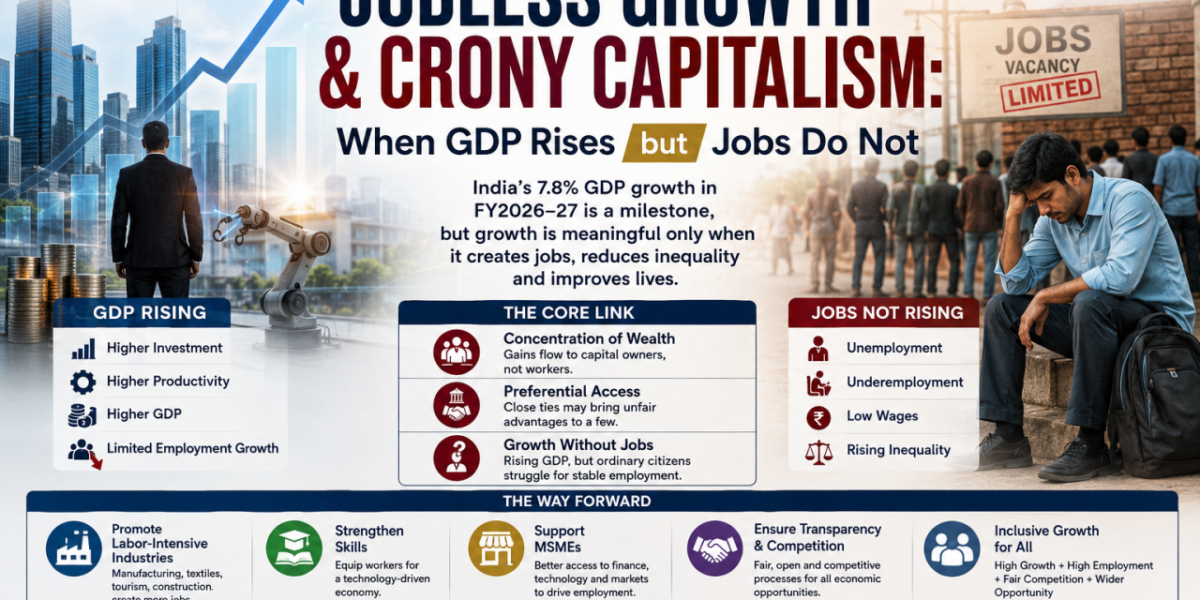
Economic growth is generally considered a sign of prosperity, but rising GDP does not always mean rising employment or incomes for everyone. When an economy expands without creating a proportionate number of jobs, it is often described as jobless growth. This phenomenon becomes particularly concerning when economic gains are concentrated among large corporations and capital owners while a significant section of the population remains unemployed, underemployed or dependent on low-paid informal work.
Jobless growth does not automatically mean crony capitalism, but the two issues can become closely connected when economic growth is accompanied by wealth concentration, limited employment creation and perceptions of preferential treatment for politically connected businesses.
I. What is jobless growth?
Jobless growth occurs when GDP and productivity increase but employment grows slowly or fails to keep pace with the expanding economy.
Technology and automation are important factors. Artificial intelligence, software, robotics and advanced machinery allow companies to produce more with fewer workers. Capital-intensive sectors such as telecommunications, energy, digital infrastructure and large-scale industries can therefore contribute significantly to GDP while creating relatively fewer jobs.
The result can be:
Higher Investment → Higher Productivity → Higher GDP → Limited Employment Growth
Technology itself is not the problem. The challenge arises when new industries and opportunities fail to absorb workers displaced from traditional occupations or young people entering the labour market.
II. How does it relate to crony capitalism?
Crony capitalism broadly describes an economic system in which businesses are perceived to gain advantages through close relationships with political power rather than through competition alone.
The connection with jobless growth can emerge through three channels:
1. Concentration of wealth
When growth is driven primarily by capital & technology, a greater share of the gains may flow to business owners & investors rather than workers. If wages & employment do not rise proportionately, inequality can increase.
2. Preferential economic access
Critics of crony capitalism argue that government contracts, public resources, financing, infrastructure concessions or regulatory decisions can sometimes disproportionately benefit a limited number of large corporations.
Such claims must be evaluated on evidence, transparency and competition rather than political rhetoric.
3. Growth without broad employment
When headline GDP rises rapidly but ordinary citizens continue to struggle to find stable employment, questions naturally arise about who is benefiting from economic growth.
This is especially important in India, where millions of young people seek productive and secure employment.
III. India’s 2026 GDP debate
India’s economic debate intensified after real GDP growth was reported at 7.8% for the April–June quarter of FY2026–27.
The government presented the strong growth figure as evidence of India’s economic resilience and strength despite global economic disruptions. Opposition leaders, however, argued that GDP growth alone does not capture the economic difficulties faced by ordinary citizens. Congress President Mallikarjun Kharge questioned whether strong headline growth adequately reflected concerns surrounding unemployment, prices, inequality and other economic pressures. The debate therefore raises a fundamental question:
Can rapid GDP growth be considered fully successful if it does not generate sufficient employment and income opportunities for a broad section of society?
IV. GDP is not the whole story
GDP measures economic output, but it does not directly measure:
- Number and quality of jobs
- Wage growth
- Income distribution
- Wealth inequality
- Job security
- Household financial conditions
Therefore, economic performance should be judged through a broader set of indicators:
GDP Growth + Employment + Real Wages + Productivity + Inequality
A country can achieve high GDP growth while simultaneously experiencing weak employment growth. This is the central concern behind the debate over jobless growth.
V. The way forward
India does not need to choose between technological progress and employment. It needs policies that make growth more employment-intensive and inclusive.
a. Promote labor-intensive industries
Manufacturing, textiles, food processing, tourism, construction and other employment-intensive sectors can generate large numbers of jobs.
b. Strengthen skills
Workers need training that matches the requirements of a rapidly changing, technology-driven economy.
c. Support MSMEs
Small and medium enterprises can create substantial employment if they receive better access to finance, technology and markets.
d. Ensure transparency and competition
Government contracts, public resources and economic opportunities should be allocated through transparent and competitive processes.
VI. Conclusion: Growth must create opportunity
India’s 7.8% GDP growth is an important economic achievement, but GDP alone cannot tell the complete story. The real measure of successful growth is whether it produces jobs, rising incomes, economic mobility and opportunities for ordinary citizens. Jobless growth becomes socially and politically dangerous when people see the economy expanding but do not experience corresponding improvements in their own lives. Similarly, allegations of crony capitalism should be examined through evidence concerning competition, transparency, corporate concentration and institutional accountability, rather than accepted simply as political claims.
The ultimate goal should be:
High Growth + High Employment + Rising Productivity + Fair Competition + Wider Opportunity
Because economic growth becomes meaningful only when people have the opportunity to participate in –and benefit from—it.