

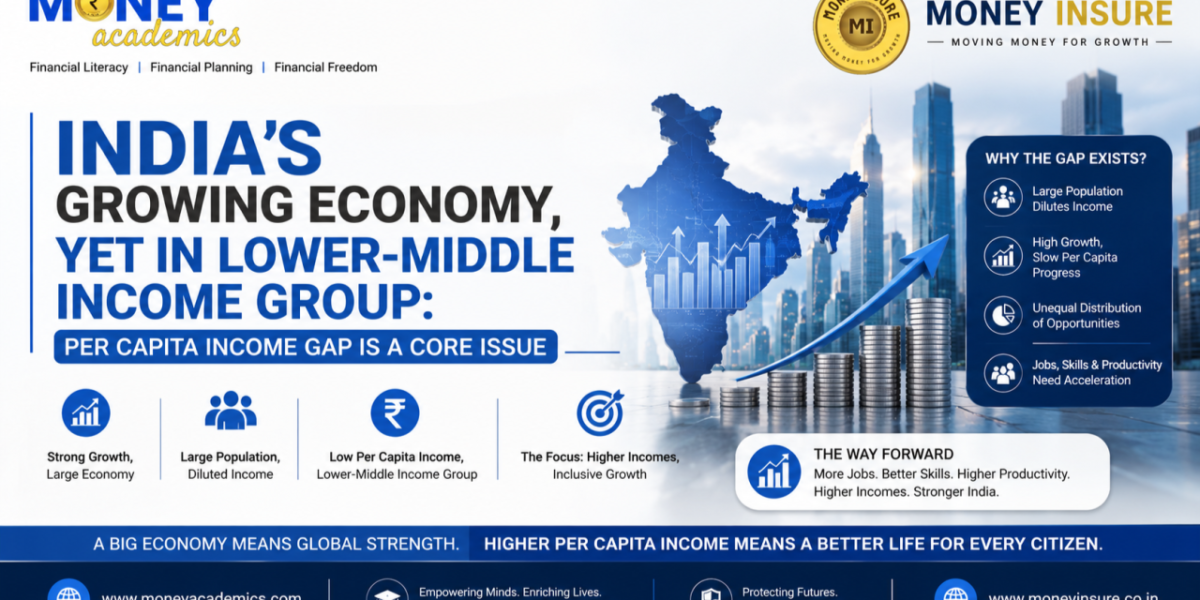
India is one of the world’s fastest-growing major economies and has recently become the 5th largest economy by nominal GDP. Yet, according to the latest World Bank classification, India remains a lower-middle-income economy, while countries such as Sri Lanka, Vietnam, and the Philippines have moved into the upper-middle-income category.
At first glance, this may seem surprising. However, the explanation lies in one key indicator—Gross National Income (GNI) per capita.
1. Why has Sri Lanka moved ahead?
The World Bank recently upgraded Sri Lanka to the upper-middle-income category after its remarkable recovery from the 2022 economic crisis. Supported by IMF-backed reforms, debt restructuring, fiscal discipline, a revival in tourism, and higher remittances, Sri Lanka recorded around 5% economic growth in 2025, allowing its GNI per capita to cross the World Bank’s upper-middle-income threshold. Similarly, Vietnam and the Philippines have also been upgraded after years of sustained industrial growth, export expansion, and increasing foreign investment.
2. Why is India still a Lower-Middle-Income economy?
The World Bank does not classify countries based on the size of their economy or GDP. Instead, it uses GNI per capita, which measures the average income earned by each resident. For the 2026–27, classification is as under:
- Lower-Middle Income: US$1,136–4,495
- Upper-Middle Income: US$4,496–13,935
India’s GNI per capita is currently estimated at around US$2,600, placing it well within the lower-middle-income category.
Although India’s economy is expanding rapidly, the benefits of growth are shared among a population of over 1.4 billion people, resulting in a slower rise in average income per person. Though population dividend may be a plus point yet over population is a stumbling block to enhance per capita GDP. It also shows that inequalities are increasing as few capitalists are grabbing the opportunities and enhancing their capital. It will remain an impediment till government takes positive measures to enhance the income of the common man especially peasants and agricultural labour.
3. Per Capita Income comparison in Asia
| Country | GNI per Capita (Atlas Method, Current US$) | World Bank Income Group (FY2027) |
| Singapore | 93,760 | High Income |
| Japan | 36,990 | High Income |
| South Korea | 37,660 | High Income |
| Malaysia | 11,930 | Upper-Middle Income |
| China | 13,690 | Upper-Middle Income |
| Thailand | 7,810 | Upper-Middle Income |
| Indonesia | 5,180 | Upper-Middle Income |
| Vietnam | 4,970 | Upper-Middle Income |
| Philippines | 4,970 | Upper-Middle Income |
| Sri Lanka | 4,670 | Upper-Middle Income |
| India | 2,650 | Lower-Middle Income |
| Bangladesh | 2,780 | Lower-Middle Income |
| Nepal | 1,500 | Lower-Middle Income |
| Pakistan | 1,580 | Lower-Middle Income |
| Afghanistan | 500 (approx.) | Low Income |
Source: World Bank, World Development Indicators – GNI per capita, Atlas method (Current US$) and World Bank FY2027 Country Income Classifications (based on 2025 Atlas GNI per capita).
The comparison clearly shows that several Asian countries with much smaller economies have higher average incomes than India.
4. The road ahead for India
India’s economic fundamentals remain strong, supported by rapid digitalization, infrastructure development, manufacturing growth, expanding services, and rising foreign investment. However, moving into the upper-middle-income category will require more than sustained GDP growth.
India must focus on:
- Creating high-paying employment opportunities
- Improving labour productivity and skills
- Expanding manufacturing and exports
- Increasing female workforce participation
- Strengthening education and healthcare
- Reducing income inequality
5. Conclusion
India’s lower-middle-income classification should not be interpreted as a sign of economic weakness. Instead, it reflects the challenge of raising average incomes across the world’s most populous nation.
The country’s economic growth story is impressive, but the next milestone is ensuring that this growth translates into higher incomes and improved living standards for every citizen. As per capita income continues to rise through structural reforms and inclusive development, India is well positioned to join the ranks of upper-middle-income economies in the coming years.
Economic size reflects a nation’s strength, but per capita income reflects the prosperity of its people. India’s future success will depend on achieving both.